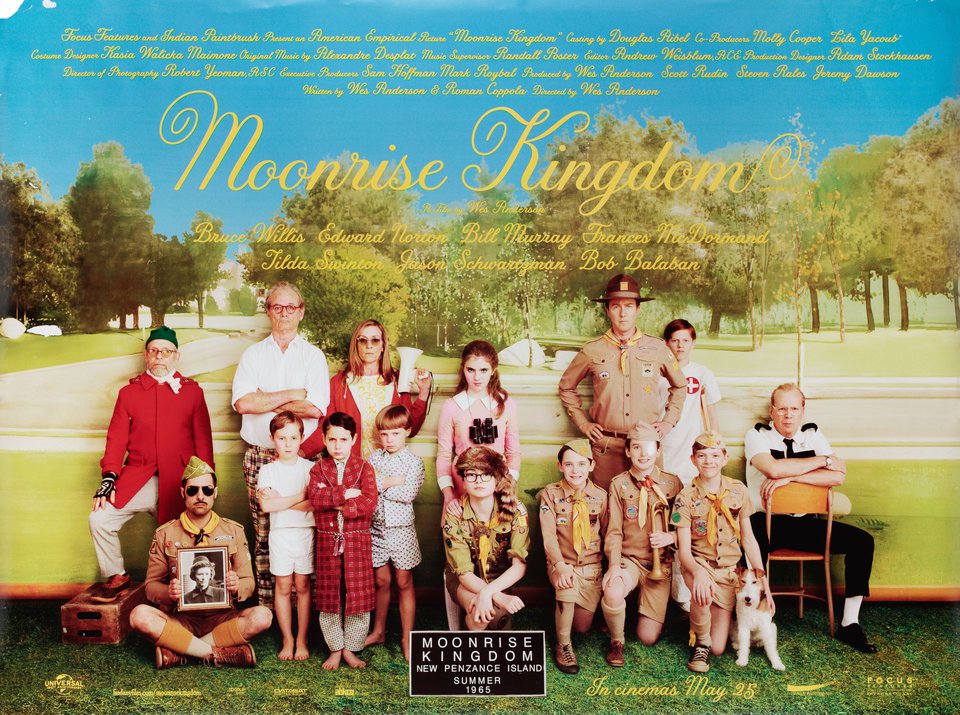
All my life, I’ve wanted to live inside of a Wes Anderson film. It was at the age of twelve that I encountered his offbeat comedy, Moonrise Kingdom: pastel colors, perfect symmetry, and poignant acting. It was there, on the fictional island of New Penzance, that I realized the true potential of movies to tell human stories. It amazed me how Anderson used the medium of film to communicate the unique beauty that can be found in loneliness and the love that exists even in broken families. It was the first time I understood how essential the screen is for capturing the truth of human existence, even through a polish of quirky colors and deadpan humor.
Before long, I started to apply the archetypal themes presented in film to my own life. I saw my younger self in Henry Selick’s Coraline. After my parents’ divorce, I had to navigate two family systems and adjust to my father’s move to Texas — a place that felt as strange and dreamlike as Coraline’s “Other World.” While she crawled through the blue tunnel, I boarded planes between Utah and Texas for holiday visits, learning how to live in two worlds at once.
Years later, I healed a piece of my inner child after I witnessed my favorite childhood toy get its own motion picture. After my first viewing of the 2023 Barbie movie, I found myself in tears. To some, the Barbie movie was a silly comedy that featured tacky pop music. To me, though, it was an affirmation of growth, identity, and girlhood.
As I grew older, I continued to find myself in film, recognizing my relationship with my chronically ill mom in Greta Gerwig’s Lady Bird and my own coming-of-age in every imperfect character that I encountered on screen.
The more I watched, the more I realized movies are not simply forms of entertainment, but rather windows into the human mind. I became curious about how stories could transform lives and reflect our inner-most selves.
That curiosity eventually led me to psychology. Psychology 1010 was my first college-level course, which I took in high school through concurrent enrollment. I was the youngest student in the room, yet I stayed up late researching concepts beyond the class material, determined to understand what drives people to think, feel, and act the way they do. To me, psychology was another form of storytelling: listening to the narratives people carry and making sense of their struggles and hopes.
Eventually, my passion for psychology and film merged. In my junior year, I took a filmmaking class. For our final project, we all received the same prompt: “There is a box.”
While most of my classmates wrote comedies, I created a short film inspired by my aforementioned favorite director, Wes Anderson, and his 2023 film Asteroid City. My story followed a girl grieving her grandmother, who left behind a single cardboard box. Inside it was a VHS tape filled with their shared memories. My teacher praised the film’s emotional depth and awarded me extra credit for “thinking outside the box”— literally and figuratively.
Throughout high school, I’ve also used storytelling mediums beyond film as a way to connect with others and find common ground. As editor-in-chief of my school newspaper, I used my love for human narratives along with the English language to tell stories of homelessness, racism, and the censorship of student voices. In the clubs DECA and FBLA, I learned how to frame real-world business narratives in ways that tapped into consumer psychology and compelled businesspeople to consider the ethics of their industry. Whether it was supporting classmates through hard times in Hope Squad (a suicide prevention organization) or creating service projects as president of my high school’s Interact Rotary International chapter, I saw firsthand how people’s lives are shaped by the stories they carry and how, fundamentally, we are all more similar than different.
Storytelling, in all of its many wonderful forms, has taught me how to embrace both the beauty and the brokenness of the world, and help others do the same. One day, I hope to major in psychology and become a therapist. Just as Moonrise Kingdom taught me that even painful stories can be beautiful, I want to spend the rest of my life uncovering meaning in others’ lived experiences and sharing that beauty with the world.